Most of us experience files as a solved problem. You click, things open. You share a link, someone else can see it. The machinery underneath that stores, moves, and indexes files is invisible until it breaks.
For creative teams, it broke years ago. The emergence of 4K and ProRes workflows, multi-terabyte project archives, and globally distributed editing teams throttled the architecture of legacy cloud storage that were built to handle documents and low-res media. Creatives were left behind to bear the brunt of wasting multiple days each week for terabytes in data egress or hard drives to arrive in the mail.
What's changed is that the niche is starting to swallow the whole: the explosion of AI-generated content means that soon, every company and function will be producing the scale of content that only creatives dealt with before. And one layer below that, in the foundational industries that Construct is focused on, data from the physical world is being harvested at a scale that dwarfs anything the creative industry has faced to date. A robotics company training a manipulation model ingests massive quantities of sensor data, egocentric video, and point clouds every week. A single autonomous vehicle can generate 4TB of data in a day, representing >7,000 petabytes of Waymo data alone in 2026. And yet the infrastructure we use to manage files hasn't meaningfully changed in two decades.
That's why we're proud to back Brandon and Emerson at Shade in co-leading their oversubscribed $15M round alongside Keith Rabois at Khosla Ventures.
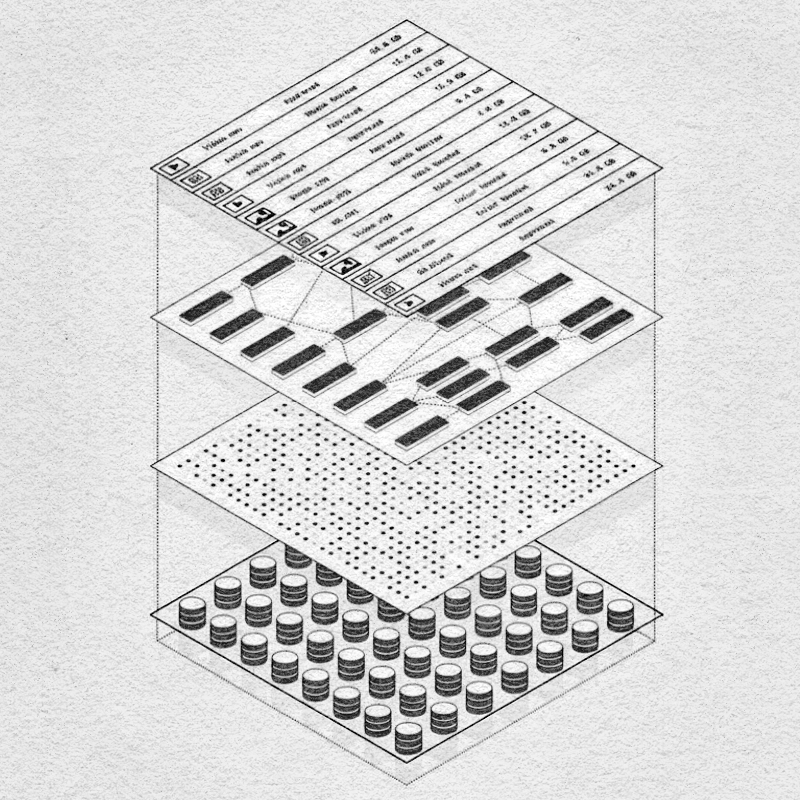
Shade is the AI-native file system for the File Abundance Era. While others are building search layers or a better interface on top of existing storage, Shade is delivering a ground-up reconstruction of how files are stored, accessed, understood, and used. The foundation is a distributed streaming file system built at the OS level, so a multi-terabyte library behaves like a local drive – think Netflix for files. With Shade, a cinematographer in New York and a colorist in Manila can work off the same master file in real time. And custom-distilled multimodal AI models turn previously dark, inaccessible archives into structured, queryable intelligence including facial recognition, auto-tagging, and natural language search across massive libraries.
It will be exceedingly difficult for either of the two incumbent camps to catch up from where they stand. On one side, legacy platforms like Google Drive, Dropbox, and Box are incentivized to sell lots of seats with light storage at predictable pricing for those who mainly live in presentations, documents, and spreadsheets. On the other are creative-oriented point solutions like LucidLink, Frame.io, and Air that each solve one slice of the workflow but force teams to stitch together many tools that were never designed to talk to each other.
The traction reflects that: within roughly a year of launch, Shade is ingesting more than 50TB of new data per day, eclipsing competitors who have been in this space for close to a decade. Customers span an unusual range of industries, from global agencies and sports organizations to Fortune 1000 enterprises. Increasingly, customers are ditching five to seven different vendors to consolidate on Shade as their single foundation, saving tens of thousands in the process.
When we met Brandon and Emerson, it was clear they had lived the problem firsthand. Brandon came up as a creative before becoming an AI researcher specializing in information retrieval and vector search. Emerson's background spans robotics, space systems, and filmmaking. Together, they bring the exact combination of customer empathy and technical depth that a problem this hard requires. They built a team who intuitively gets the problem — many early hires are creatives themselves — and recruited go-to-market operators from the early days of LucidLink, Frame.io, Notion, and Figma who know exactly where the existing solutions break down.
Shade recognized creative teams as the canary in the coal mine, and will soon enough feel the enormous pull from physical AI. The companies that defined the last generation of creative software all started narrow and ended up trying to build the connective tissue for entire organizations. We believe Shade is building the same kind of infrastructure for the age of AI, where the files are bigger and more numerous, the workflows are more dynamic and distributed, and the stakes are only getting higher.
Learn more at shade.inc.